Where The East Meets Italy
The fashion, art and cultural heritage of China and Italy came together inside one of the most iconic historic palaces in the Renaissance city.
On October 11, 2026, the Italian city of Florence hosted Where the East Meets Italy, a cultural gathering that brought together fashion, art, music and artisanal traditions from China and Italy for a day dedicated to creative exchange between the two cultures. Held at the historic Palazzo Pucci, the event opened a dialogue between East and West through a fashion show, a cultural heritage exhibition and a concert celebrating the musical traditions of both countries.
Just steps from the Cathedral of Santa Maria del Fiore, Palazzo Pucci preserves centuries of history associated with one of Florence’s most influential families. Its origins date back to 1480, when Antonio Pucci acquired the first properties that would eventually form this Renaissance residence. Its halls, frescoes and architectural details reflect the artistic splendour of the city.
Centuries later, the palace would become part of another chapter in Italian fashion history. In 1947, Marquis Emilio Pucci established his fashion house there, where his vibrant prints and innovative designs went on to captivate the international fashion scene, earning him the nickname Prince of Prints. The building remained the brand’s headquarters until 2017 and continues to foster creativity through the Emilio Pucci Heritage Hub and the educational spaces of IED Firenze, bringing fashion history and new generations of designers together under one roof.

Choosing this landmark palace as the setting for Where the East Meets Italy gave the gathering a particular significance. Surrounded by frescoed halls, Renaissance architecture and centuries of history, Florence’s artistic legacy provided the backdrop for a celebration in which tradition and contemporary creativity found common ground. With its longstanding ties to art, craftsmanship and Italian fashion, the venue reflected the very essence of the event: building bridges between cultures through the qualities that make each one unique.


A Cultural Exchange Rooted in Dialogue
Behind Where the East Meets Italy is an initiative dedicated to bringing the artistic expressions of China and Italy closer together, creating a space for exchange in which fashion, music and artisanal heritage become bridges between the two cultures.
The inaugural edition was presented by Nantong Qiaoren International Trade Co., Ltd., the event’s main sponsor, alongside CUBO Art & Culture and West China Couture Fashion Center, in collaboration with its founding partners in China, AMC Art Ceramic Chengdu and Aba Folk Heritage Park.
The project was conceived and organised under the leadership of Mengyun (Luna) Gu, who spearheaded the initiative and founded CUBO Art & Culture, together with Ina Meng, project director; Youyou Zhou, production lead and curatorial collaborator; and Zeyi Xie, art curator.
Supported by the Federation of Overseas Chinese Associations in Florence, the Italy-China Youth Federation and Europe Health, the gathering marked the beginning of a project designed to extend beyond its inaugural edition in Florence and continue fostering cultural connections through future events in Italy and other European countries.
The project’s vision extends beyond bringing different artistic disciplines together in a single space. Its purpose is to celebrate cultural heritage and artisanal techniques passed down through generations while opening new opportunities for collaboration among creators, artists and institutions from both countries.
CUBO Art & Culture plays a central role in this dialogue. Founded in Florence in 2023, the platform was created to connect China and Europe through music, fine arts, design and culture. Its work includes collaborations with conservatories, cultural institutions and international organisations, reflecting a vision in which art becomes a meeting point for different sensibilities.
With this first edition, Where the East Meets Italy launched a cultural initiative intended to grow over time. Its organisers have announced a next gathering in January at a villa in Signa, near Florence, followed by future editions in Milan, Rome and other European countries. It marks the next chapter for a project seeking to keep the exchange between cultures, traditions and emerging creative generations alive.


Among the different expressions that brought Where the East Meets Italy to life, Chinese cultural heritage took centre stage through The Craft of Memory, an exhibition curated by Zeyi Xie. Bringing together more than 90 pieces, the exhibition explored the richness of artisanal traditions and their enduring presence across time.
Built around the idea that cultural memory resides not only in objects but also in the knowledge, techniques and gestures passed from one generation to the next, the exhibition invited visitors to discover art as a living inheritance: one capable of evolving without losing its roots.
The journey continued in the Sala dell’Arte, dedicated to Craft and Custom, where calligraphy, painting, Miao community batik, Dixi and Nuo ceremonial masks, and traditional embroidery revealed how cultural identity is preserved through the hands of its makers. Finally, the Sala delle Nuvole, titled Continuity and Renewal, explored how these practices continue to evolve through embroidery, textiles, contemporary design and audiovisual expressions.
Among the participating artists was Yang Bingjun, a master of intangible cultural heritage from Hebei, whose paintings made with natural reeds transform an everyday material into delicate artistic compositions. Porcelain also held a significant place in the exhibition through Yu Xiaoyao, whose work is connected to the ceramic tradition of Jingdezhen. Meanwhile, Xu Jingxuan presented Dasheng (2022), a Jun porcelain sculpture whose distinctive pinkish-purple glaze emerges through the transformations that occur during firing.


The calligraphy of Ke Yulin, alongside works by Feng Keyong, Chen Hu and Master Ming Dao, expanded this exploration of Chinese artistic expression. They were joined by Wan Xi, a Chinese artist based in Florence, whose work Still Growing combines oil painting on wood with Tuscan clay, establishing a material connection between the two cultures.
The exhibition also featured Gems of Civilisation, an audiovisual work dedicated to traditional Nuo opera, with photography and production by Michelle Wang and dance by Yiqing Dong. The piece extended the exploration of heritage beyond physical objects, bringing it into the realms of movement and performance.
Music also found its place in this cultural exchange. As evening fell, the Sala di Apollo hosted the Italy-China concert, produced by CUBO Art & Culture, where the musical traditions of both countries came together in a programme of ten performances featuring Chinese folk songs, instrumental compositions and celebrated Italian opera arias.
The voices of Zhang Linglin, Chen Yaoying, Renata Cimmino and Gu Mengyun shared the spotlight with instrumental performances by Gabriele Chionna, Pu Xueqing and Mia Ferrara. The repertoire moved between Chinese compositions such as Nostalgia for Mother and Song of the Yue Boatman and works by renowned Italian composers including Giacomo Puccini, Gioachino Rossini and Francesco Paolo Tosti.
Between the delicacy of artisanal techniques and the expressive power of music, the gathering offered a glimpse into two ways of preserving cultural identity: one through the materials and the hands that transform them, the other through voices and melodies that continue to resonate across generations.


A Journey Through Major Fashion Houses and Independent Creation
Fashion as a language between cultures
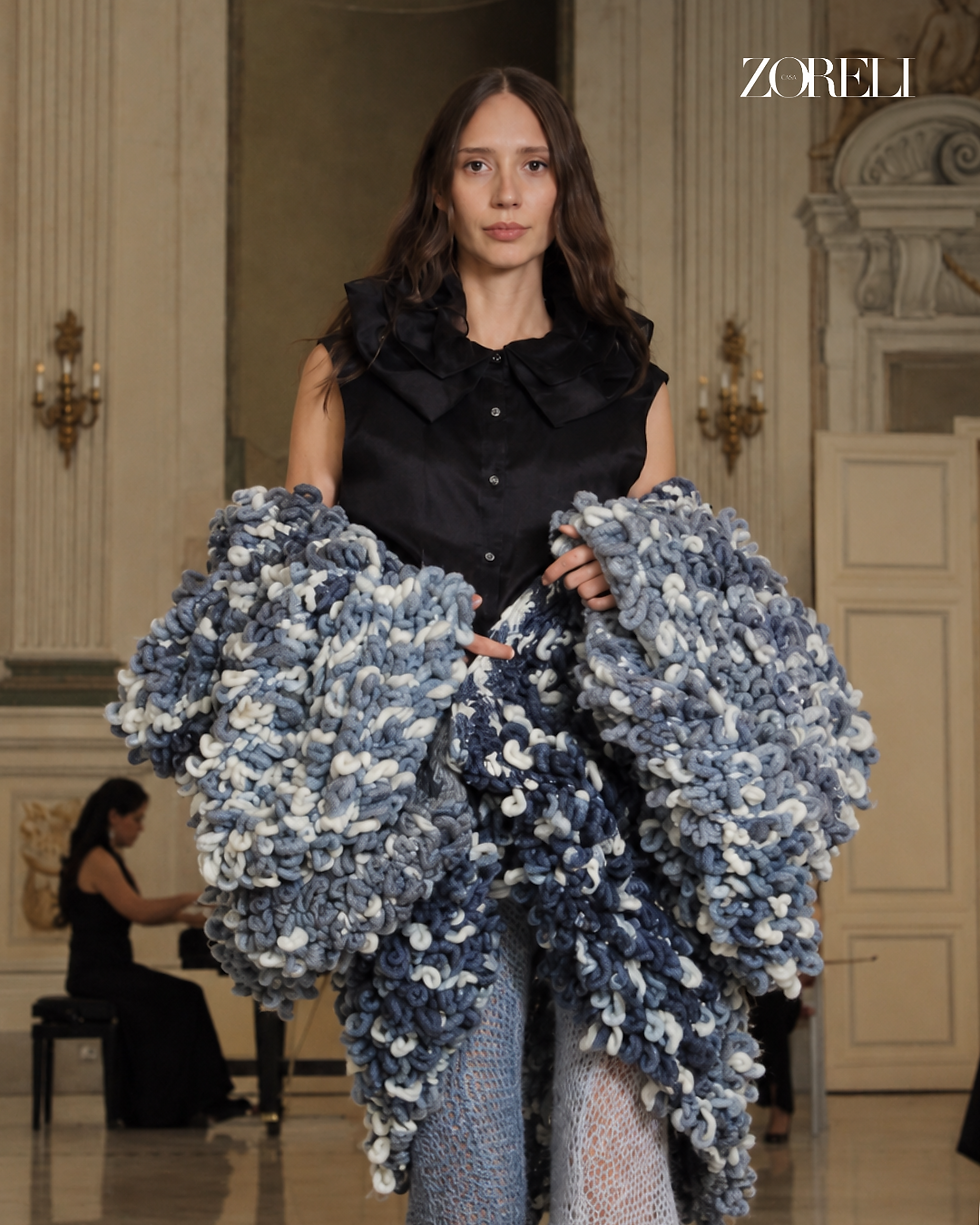
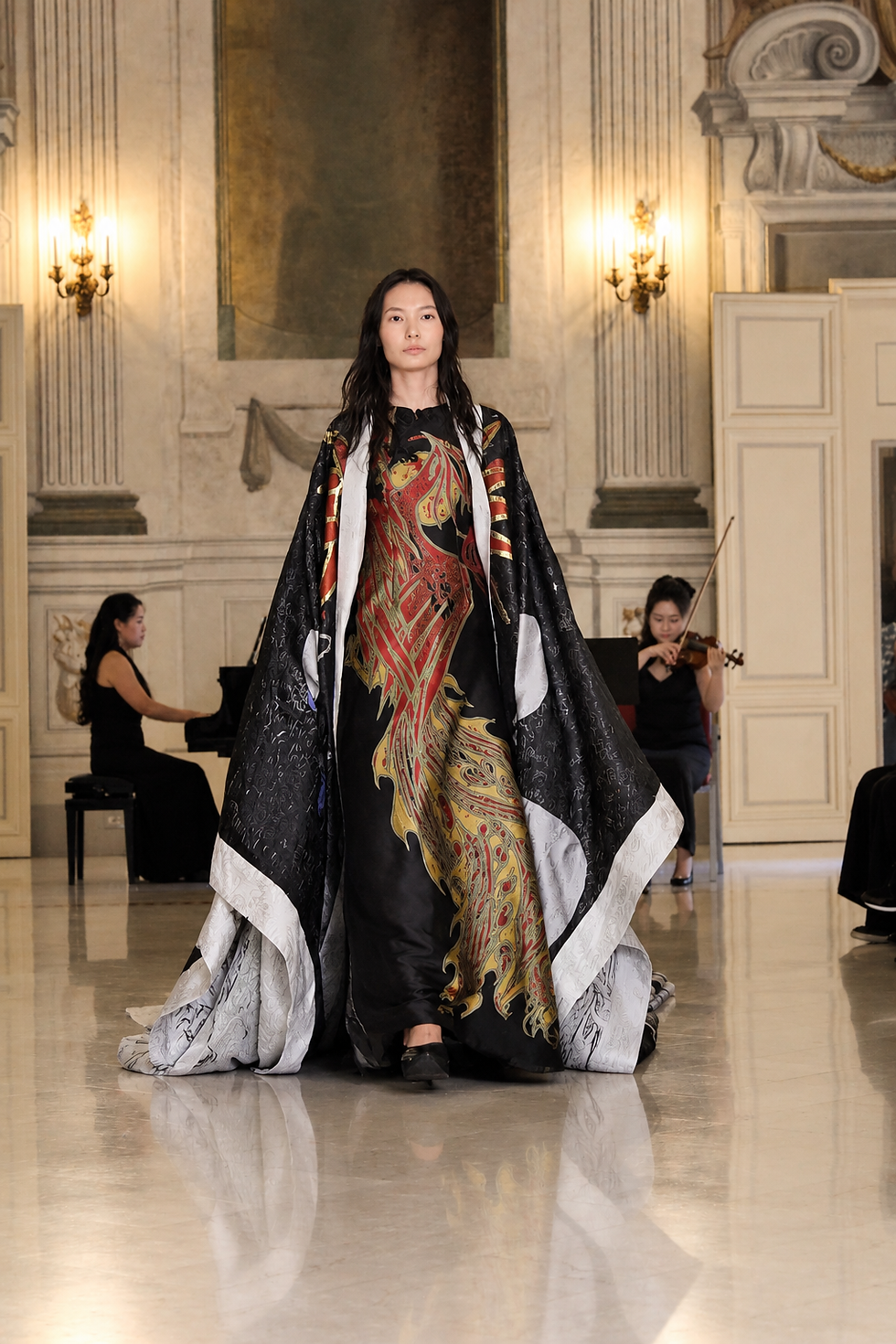
The event also brought fashion into focus. In the Sala di Apollo, surrounded by the frescoes and historic architecture of Palazzo Pucci, designers Alicia Gu, representing Chinese design, and Regina Branca, representing Italy, presented their creations in a runway show that explored the meeting of two cultural identities through their distinct approaches to fashion.
The show opened with the two designers’ collections presented in alternation, allowing audiences to appreciate each creative language before the proposals came together within the same setting. Twelve international models brought the designs to life, accompanied by live piano and violin performances by CUBO Art & Culture, adding a musical dimension to the presentation.
Produced by Youyou Zhou, the show featured styling by Emanuela Saviano, Gaia Romoli and Shaline Vakkalagadda, while Irene Miniati led hair and makeup. Thiago Palía was responsible for the audiovisual production, documenting a meeting in which each creation found its place within a shared narrative.
Rather than seeking similarities between two approaches to design, the runway allowed each collection to retain its own identity. It was an expression of how fashion can become a space for exchange, where different traditions, sensibilities and creative perspectives can engage with one another without losing what makes them unique.


During our coverage of Where the East Meets Italy, by Antonio Pando (Creative Director of Casa Zoreli) and Arturo Bernal, we had the opportunity to speak with Regina Branca, a 22-year-old Italian designer from Sicily. A graduate of Istituto Marangoni in Florence, she is currently pursuing a master’s degree at the Royal College of Art in London. Her passion for fashion began in childhood, inspired by her mother and grandmother, who awakened in her a particular sensitivity to clothing as a form of self-expression and identity.
For the runway, she presented Metamorfosis, a collection inspired by her homeland and the ancient Greek myth of Arethusa, the nymph whose transformation into water symbolises freedom, nature and change. Through crochet, knitwear, felt and textile experimentation, Regina spent a year translating the legend into a contemporary proposal. Among the standout pieces was a sculptural green dress, whose development required more than two months of artisanal research.
For the designer, presenting her work at Palazzo Pucci was a particularly meaningful moment. Her participation also gave her an opportunity to reflect on the connections between Italy and China, two cultures that, despite their geographical distance, share a deep respect for family, craftsmanship and traditions passed down through generations. This perspective captures her creative philosophy: preserving the past does not mean keeping it unchanged, but finding new ways for it to evolve.
A Shared Legacy
Beyond their cultural and geographical differences, Where the East Meets Italy offered a reflection on what unites two civilisations with centuries of history. China and Italy, each with its own traditions, found in fashion, art and craftsmanship a language capable of transcending borders.
Between the intricacy of China’s ancestral techniques and the richness of Italy’s artistic heritage, the gathering showed that traditions do not need to lose their identity to engage with others. On the contrary, it is precisely through their differences that new perspectives, creative possibilities and ways of understanding the world emerge.
Because the true value of cultural exchange lies not in transforming one culture into another, but in discovering how both can enrich one another while preserving their histories and making room for new generations of artists and creators. In Florence, this vision found its first stage, with the ambition to continue reaching beyond borders, much like art itself